Introspecting a DIgSILENT PowerFactory IEEE 39-Bus model via MCP
MCP Toolcall and introspection
The basic concept of this exercise is to demonstrate how an MCP interface can provide a useful way of extracting and collecting data from an existing model. An engineer can of course open the model directly in whatever software package they are using, but this can be sometimes tedious and time consuming, especially when you are looking across a range of different equipment and parameters. Introspecting a project is useful as it lets you understand and query different parameters and settings and configurations, but really the key benefit of this is that you are creating a data pipeline between the software and the AI.
The results of the introspection don’t really tell us anyhthing we would not already know or be able to find out in other ways. The point of the exercise is the process and the results and accuracy of the retrieval.
IEEE 39-Bus Model
The IEEE 39-Bus model is a well known system (also called the New England system), and used a lot in academia and research. It is big enough to be interesting and complicated enough to show specific transmission level power systems analysis behaviour, but not so big that it gets unwieldy and difficult to follow. The network has a main transmission votlage of 345kV, and a number of strategic generators located through the system. Bus 39 and G39 represent the system external connection to a wider network.
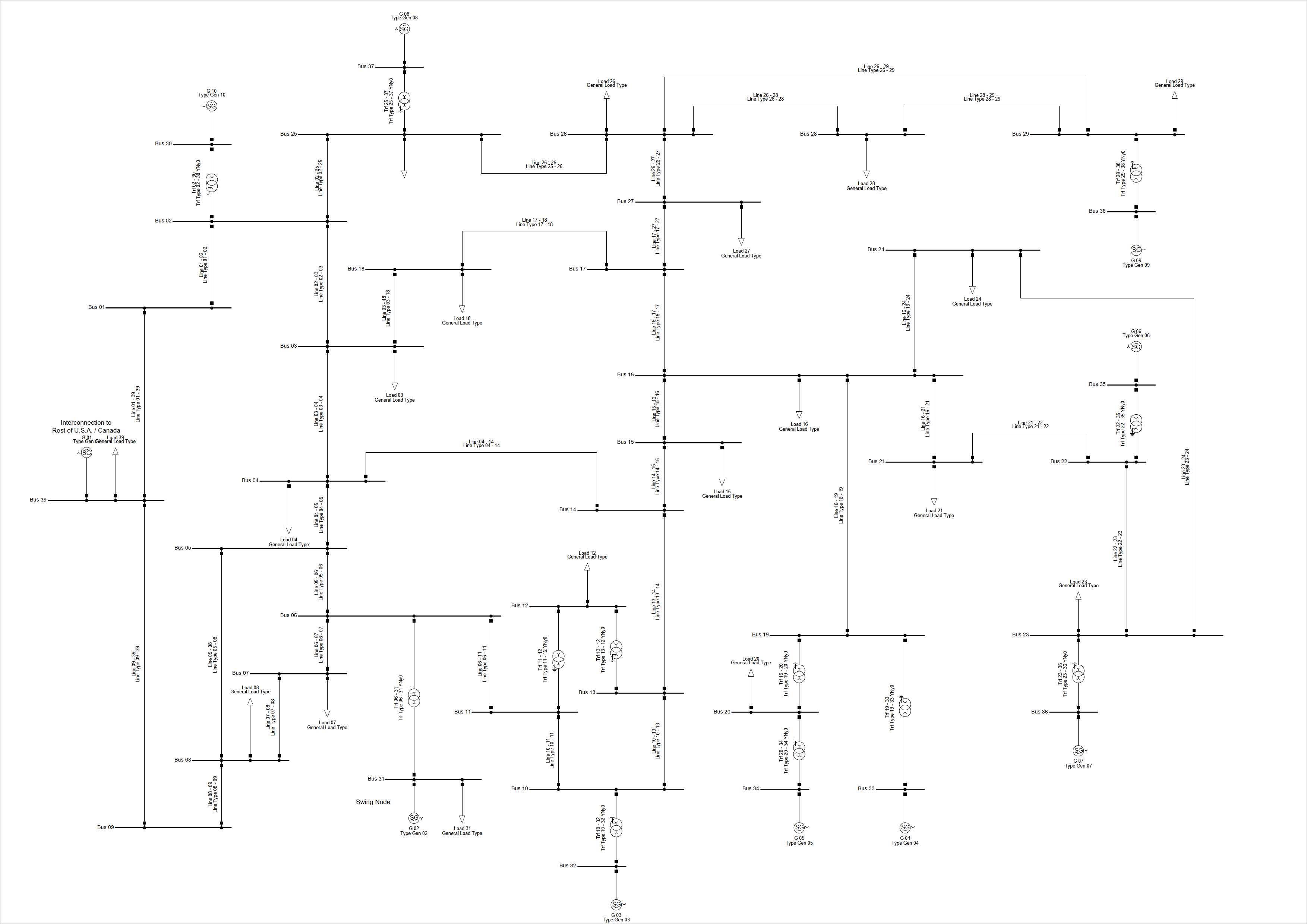
IEEE 39-Bus Introspection
At a glance
Once the MCP server is loaded, I used a pre-defined set of rules and systems to carry out an ‘introspection’ of the plant. The idea, as noted above, is that the AI gets an overview of the system and can understand its structure and network topology, identify key generators, busbars loads and control systems.
| Buses (ElmTerm) | 39 |
| Voltage levels | 345 kV (28 buses, transmission) · 230 kV (1: Bus 20) · 138 kV (1: Bus 12) · 16.5 kV (10: gen terminals) |
| Lines (ElmLne) | 34 |
| Transformers (ElmTr2) | 12 |
| Synchronous machines (ElmSym) | 10 (G 01–G 10) |
| DSL controllers | 27 ElmDsl blocks across 10 ElmComp composite frames - i.e. one controller frame per generator |
| External grid (ElmXnet) | none (so no SCR calculable) |
| Operation scenario | none active |
| Total installed | 14 535 MW / 17 100 MVA |
| Slack-equivalent | G 01 - 8 500 MW / 10 000 MVA (aggregates the NY–NE system, classic IEEE 39 convention) |
(a) Generator dispatch & dynamic data
A1. Operating point (ElmSym)
| Gen | Bus | P_dispatch (MW) | Q_setpt (MVAr) | cosφ | n_units | u_setp (pu) | Mode | Slack? |
|---|---|---|---|---|---|---|---|---|
| G 01 | 39 | 1 000 | 0 | 1.00 | 1 | 1.030 | const-V | - (Pmax=8500) |
| G 02 | 31 | 0 | 0 | 1.00 | 1 | 0.982 | const-V | ✓ ip_ctrl=1 |
| G 03 | 32 | 650 | 0 | 1.00 | 1 | 0.983 | const-V | - |
| G 04 | 33 | 632 | 0 | 1.00 | 1 | 0.997 | const-V | - |
| G 05 | 34 | 254 | 0 | 1.00 | 2 | 1.012 | const-V | - |
| G 06 | 35 | 650 | 0 | 1.00 | 1 | 1.049 | const-V | - |
| G 07 | 36 | 560 | 0 | 1.00 | 1 | 1.064 | const-V | - |
| G 08 | 37 | 540 | 0 | 1.00 | 1 | 1.028 | const-V | - |
| G 09 | 38 | 830 | 0 | 1.00 | 1 | 1.026 | const-V | - |
| G 10 | 30 | 250 | 0 | 1.00 | 1 | 1.048 | const-V | - |
Notes:
- All in PV mode (
av_mode = constv) - voltage-controlled. Q sets are 0 with cosφ=1 (LF will solve actual Q). - G 02 is the swing bus (
ip_ctrl=1). G 01 is not the slack despite its 8500 MW Pmax - its P is dispatched at 1000 MW and the rest is balanced by G 02. Classic IEEE 39 setup. - G 05 has
ngnum=2- two parallel units of 300 MVA each (so Srated_total = 600 MVA, P_tot = 510 MW).
A2. Type data (TypSym) - all on the machine’s own MVA base
| Type | Sgn (MVA) | Ugn (kV) | H (s) | xd | xq | x’d | x’q | x”d | T’d0 (s) | T”d0 (s) | iturbo |
|---|---|---|---|---|---|---|---|---|---|---|---|
| Gen 01 | 10 000 | 345 | 5.00 | 2.00 | 1.90 | 0.60 | 0.80 | 0.40 | 2.10 | 0.033 | 1 (round) |
| Gen 02 | 700 | 16.5 | 4.33 | 2.07 | 1.97 | 0.49 | 1.19 | 0.35 | 1.55 | 0.036 | 1 |
| Gen 03 | 800 | 16.5 | 4.48 | 2.00 | 1.90 | 0.42 | 0.70 | 0.36 | 1.21 | 0.042 | 1 |
| Gen 04 | 800 | 16.5 | 3.58 | 2.10 | 2.06 | 0.35 | 1.33 | 0.28 | 0.95 | 0.040 | 1 |
| Gen 05 | 300 | 16.5 | 4.33 | 2.01 | 1.86 | 0.40 | 0.50 | 0.27 | 1.06 | 0.034 | 1 |
| Gen 06 | 800 | 16.5 | 4.35 | 2.03 | 1.93 | 0.40 | 0.65 | 0.32 | 1.44 | 0.040 | 1 |
| Gen 07 | 700 | 16.5 | 3.77 | 2.07 | 2.04 | 0.34 | 1.30 | 0.31 | 0.94 | 0.045 | 1 |
| Gen 08 | 700 | 16.5 | 3.47 | 2.03 | 1.96 | 0.40 | 0.64 | 0.32 | 1.32 | 0.039 | 1 |
| Gen 09 | 1 000 | 16.5 | 3.45 | 2.11 | 2.05 | 0.57 | 0.59 | 0.45 | 1.30 | 0.039 | 1 |
| Gen 10 | 1 000 | 16.5 | 4.20 | 1.00 | 0.69 | 0.31 | 0.50 | 0.25 | 3.16 | 0.040 | 0 (salient) |
Three things stand out:
- G 01 is the system equivalent - connected directly at 345 kV (no step-up, no
Trf 01-xxexists), Sgn 10 GVA, H = 5 s, modelling the rest of the NY-NE interconnection. - G 10 is the only hydro unit -
iturbo = 0, much lower xd (1.0 vs ~2.0), large saliency, very long T’d0 (3.16 s). - All others are round-rotor thermal with classical reactances (xd ≈ 2.0, xdss = xqss = 0.27–0.45). Equal d/q subtransients is the standard simplification.
System inertia: weighted-by-MVA mean H ≈ 4.4 s at machine base, ≈ 4.4 GW·s/GVA × 17.1 GVA = 75 GW·s total stored kinetic energy. Removing G 01 (which is the equivalent rest-of-system, not a real machine) leaves ≈ 30 GW·s for the 9 study-area machines.
(b) Controller architecture
B1. Composite frame inventory
10 ElmComp frames, 27 ElmDsl total. Pattern:
| Composite | Slots / DSL blocks | Generator |
|---|---|---|
| Power Plant 02 | AVR 02, GOV 02, PSS 02 | G 02 |
| Power Plant 03 | AVR 03, GOV 03, PSS 03 | G 03 |
| Power Plant 04 | AVR 04, GOV 04, PSS 04 | G 04 |
| Power Plant 05 | AVR 05, GOV 05, PSS 05 | G 05 |
| Power Plant 06 | AVR 06, GOV 06, PSS 06 | G 06 |
| Power Plant 07 | AVR 07, GOV 07, PSS 07 | G 07 |
| Power Plant 08 | AVR 08, GOV 08, PSS 08 | G 08 |
| Power Plant 09 | AVR 09, GOV 09, PSS 09 | G 09 |
| Power Plant 10 | AVR 10, GOV 10, PSS 10 | G 10 |
| Rest of U.S.A. / Canada | (empty - 0 DSL) | G 01 |
Confirmed: 9 plants × 3 slots = 27 ElmDsl, matching the project introspect count.
Architectural takeaway: every machine except G 01 has the classic AVR + GOV + PSS triplet. G 01, being the system equivalent, is run as an uncontrolled inertia + impedance representation - appropriate for studies where the dynamics of NY-NE are out of scope.
B2. Sample DSL parameters - Power Plant 03
| Block | Parameters returned |
|---|---|
| AVR 03 | Tr = 0.0 (regulator input filter time constant - instantaneous) |
| GOV 03 | Pmax = 1.0, Pmin = 0.0, T1 = 0.2 s, T2 = 1.0 s, T3 = 0.6 s, T4 = 0.6 s |
| PSS 03 | T1 = 3.0 s, T2 = 0.2 s, T3 = 2.0 s, T4 = 0.2 s, Vmax = +0.2 pu, Vmin = −0.2 pu |
Caveats:
- The DSL tool only surfaces the parameter names it knows about (WECC + common IEEE legacy names). The AVR returning just
Trstrongly suggests it’s a minimal IEEE-DC1A or simplified Type-1 with most other parameters under non-standard names - they’re in the model but the tool didn’t enumerate them. Same for GOV. - The PSS pattern (two lead-lag stages T1/T2 + T3/T4 + a ±0.2 pu output limiter) is the classic IEEE PSS1A / IEEEST single-input stabilizer signature.
- The GOV signature (Pmax/Pmin + T1–T4) is consistent with a TGOV1 / IEEEG1 simplified thermal governor.
If you want a definitive identification of the DSL block models, the next step is to read each block’s typ_id (BlkDef reference) - that gives the actual block-frame name. Tell me and I’ll fetch those.
(c) Network topology
C1. Voltage levels in use
| kV | Buses | Role |
|---|---|---|
| 345 | 28 (Bus 01–29 minus 12, 20 + Bus 39) | transmission backbone |
| 230 | 1 (Bus 20) | sub-transmission island fed from Bus 19 |
| 138 | 1 (Bus 12) | sub-transmission island fed from Bus 11 & 13 |
| 16.5 | 10 (Bus 30–38 + … wait, Bus 30 not 39) | generator terminals (G 02–G 10) |
Note: G 01 sits at Bus 39 (345 kV) directly - no step-up.
C2. Lines (TypLne) - all 34 are 345 kV
Sampled 6 of 34. Identical pattern across all sampled types: uline = 345 kV, xline = 0.30 Ω/km, sline = 1.0 kA (rated current). Variation is purely in R and B:
| Line type | rline (Ω/km) | xline (Ω/km) | bline (μS/km) | sline (kA) |
|---|---|---|---|---|
| Line Type 01 - 02 | 0.0255 | 0.300 | 3.60 | 1.0 |
| Line Type 03 - 04 | 0.0183 | 0.300 | 2.20 | 1.0 |
| Line Type 09 - 39 | 0.0120 | 0.300 | 10.16 | 1.0 |
| Line Type 16 - 17 | 0.0236 | 0.300 | 3.19 | 1.0 |
| Line Type 17 - 27 | 0.0225 | 0.300 | 3.94 | 1.0 |
| Line Type 26 - 28 | 0.0272 | 0.300 | 3.49 | 1.0 |
frnom = 60 Hz (US system, as expected for IEEE 39).
The uniform xline = 0.3 Ω/km and uniform 1 kA rating are typical of benchmark-system simplifications - the author tuned R and B per branch to hit the canonical IEEE 39 impedances while keeping X identical and ratings unconstrained. No 230 kV or 138 kV lines exist - those buses are reached only through transformers.
C3. Transformers (TypTr2) - all 12, all YNy0 vector group
| Transformer | Sn (MVA) | HV (kV) | LV (kV) | uk (%) | Pcu (kW) |
|---|---|---|---|---|---|
| Trf Type 02 - 30 (G 10) | 1 000 | 345 | 16.5 | 18.10 | 0 |
| Trf Type 06 - 31 (G 02) | 700 | 345 | 16.5 | 17.50 | 0 |
| Trf Type 10 - 32 (G 03) | 800 | 345 | 16.5 | 16.00 | 0 |
| Trf Type 11 - 12 | 300 | 345 | 138 | 13.06 | 1 440 |
| Trf Type 13 - 12 | 300 | 345 | 138 | 13.06 | 1 440 |
| Trf Type 19 - 20 | 1 000 | 345 | 230 | 13.82 | 7 000 |
| Trf Type 19 - 33 (G 04) | 800 | 345 | 16.5 | 11.37 | 4 480 |
| Trf Type 20 - 34 (G 05) | 300 | 230 | 16.5 | 10.81 | 1 620 |
| Trf Type 22 - 35 (G 06) | 800 | 345 | 16.5 | 11.44 | 0 |
| Trf Type 23 - 36 (G 07) | 700 | 345 | 16.5 | 19.04 | 2 450 |
| Trf Type 25 - 37 (G 08) | 700 | 345 | 16.5 | 16.25 | 2 940 |
| Trf Type 29 - 38 (G 09) | 1 000 | 345 | 16.5 | 15.62 | 8 000 |