Power Systems · AI · Research
Practical AI-assisted analysis for power-system models and data.
Personal site of Steve Sommerville - a PhD researcher applying AI to power-systems modelling and analysis. Work spans grid-forming inverters, system strength, frequency response, HVDC and controller modelling, using publicly-available test networks - IEEE 14-bus, IEEE 39-bus, WECC/NREL 240-bus, Nordic 32-bus and the NESO Reduced GB model - so the methods stay reproducible.
Latest Technical Note
Building WECC generator models (REGC_C + REEC_C) in PSCAD with FORTRAN and AI
Building the WECC REGC_C and REEC_C inverter and generator control systems in PSCAD by getting Claude to write FORTRAN directly. Includes an agentic test regime that caught two real behaviours - a Vmin / LVRT setting conflict on sustained shallow dips, and LVRT oscillation on weak grids.
Latest Case Study
Creation of a WECC Storage Model in PSCAD Using FORTRAN (REPC, REEC and REGC)
An AI-assisted modelling exercise to build a full storage plant model in PSCAD using an MCP interface to build direct FORTRAN models of a Plant Controller (REPC), Inverter Controller (REEC) and Generator (REGC).
NESO Data
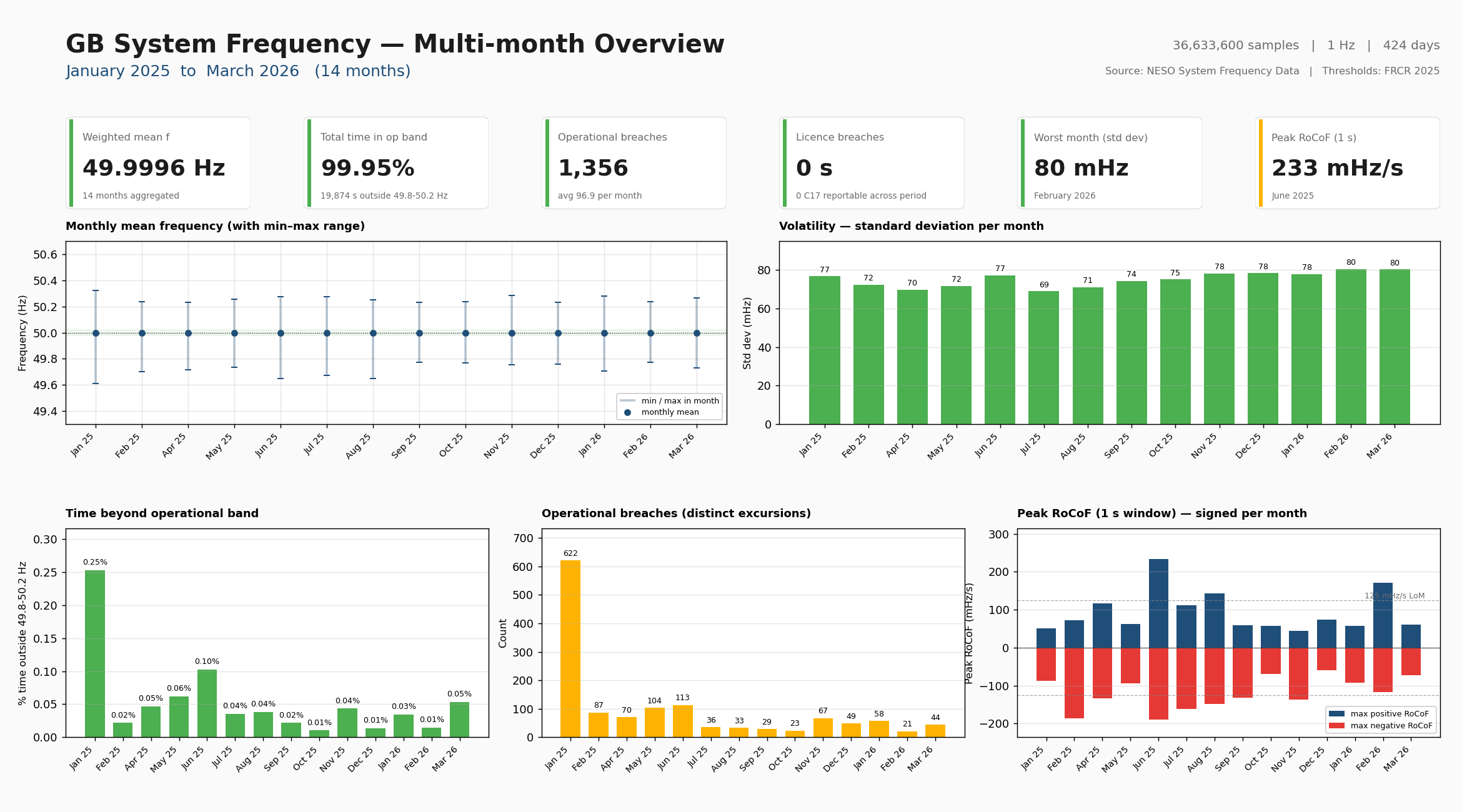
GB frequency, incidents and inertia trends
Monthly frequency dashboards, historical GC0151 / GC0105 incident trends, and a live interface to the NESO Data Portal. Built from public 1-Hz frequency data and NESO’s monthly system-incident reports.
Interactive Map
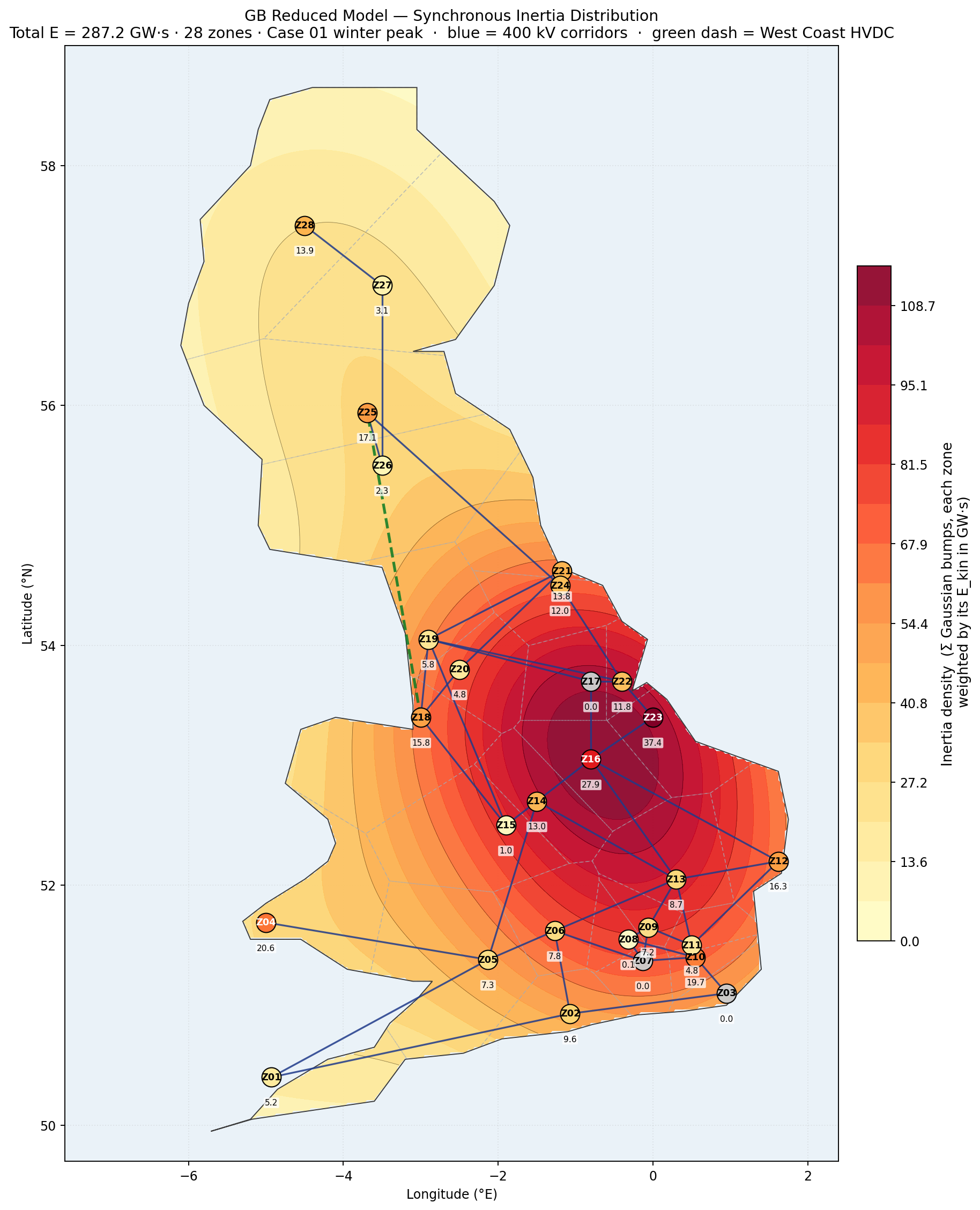
Synchronous inertia, dispatch and HVDC in one view
28-zone GB Reduced Model layered with dispatch scenarios, 400 kV corridors, HVDC interconnectors and a Live system state view built on Elexon BMRS and carbonintensity.org.uk data.
When working in research it is often beneficial to use publicly available test networks. This helps other researchers replicate findings and avoids IP and NDA concerns. The work uses publicly available models and data wherever possible. For this project I am currently focusing on five main standard models:
- IEEE 14-bus model - a simple, well-established model used for testing concepts and ideas. It is a simple test network, intended to have enough detail to let a simulation engine think and solve problems, but it is nowhere near complicated enough for a real network.
- IEEE 39-bus model (aka New England 10-machine) - a more detailed model representing a larger system with multiple voltage levels and large synchronous machines. Big enough to show interesting transmission-level behaviour, small enough to navigate easily and debug when things don’t work.
- NESO Reduced GB model - produced by the UK system operator; a reduced / simplified model of the whole GB system, split into 28 zones. A flexible generation mix, complex transmission, HVDC interconnectors and realistic transmission characteristics.
- WECC / NREL 240-bus model - produced by WECC and NREL, this is a synthetic representation of the Western Interconnection (14 US states plus parts of Canada and Mexico). It is considered particularly suitable for testing IBR-based generation integration.
- Nordic 32-bus - produced by CIGRE and represents a synthetic network of the Nordic regions. It is set up and configured to be highly stressed and produce ‘interesting’ results.
With the public models, the main areas of interest and research cover the existing and new challenges emerging with power systems analysis, and explore how AI can help us investigate them.
- Loadflow and network analysis
- System strength and short-circuit analysis
- Reduced network models and screening studies
- Synchronous inertia and frequency response
- Grid Forming Inverters
- RMS / EMT dynamic studies
- Reactive power and voltage stability
- HVDC and interconnector behaviour
- AI tooling for power-system workflows
About
I am an experienced power systems engineer with 25+ years in HV and EHV power system design and analysis. I am currently completing a PhD in Power Systems Stability at Brunel University London looking at voltage stability, sub-synchronous oscillation, damping controls for IBRs, and the modelling of system strength in inverter-dominated networks. Alongside this, I have developed a keen interest in AI and how it will transform how we do power systems analysis. I am also the Managing Director of Aurora Power Consulting.
Open to discussion and collaboration. Reach me at stevesommerville_website@proton.me.